Advancing Fertility Research Through Stem Cell Science
Infertility affects millions of individuals worldwide, yet many underlying causes—particularly those related to germ cell loss or dysfunction—remain difficult to treat. At the intersection of developmental biology and reproductive medicine, stem cell research is opening new avenues for understanding and potentially addressing these challenges¹.
Why Germ Cell Development Matters
Healthy fertility depends on the successful formation and maturation of germ cells—oocytes and sperm—that carry genetic and epigenetic information to the next generation. In humans, these cells arise through tightly regulated developmental processes that are not easily studied directly. As a result, much of what we know about early germ cell development comes from animal models or indirect clinical observation.
Stem cell–based systems offer a complementary approach. By guiding pluripotent stem cells toward germ cell–like states in vitro, researchers can observe key developmental transitions, study molecular regulation, and test hypotheses that were previously inaccessible.
Progress in In-Vitro Germ Cell Modeling
Recent advances have improved our ability to derive primordial germ cell–like cells from pluripotent stem cells and support their progression through early developmental stages. These systems allow researchers to examine how signaling pathways, cellular environments, and epigenetic mechanisms contribute to germ cell identity and viability.
In our work, we focus on building controlled, reproducible culture conditions that more closely resemble the native reproductive environment. This includes studying how germ cells interact with supporting somatic cells and how physical and biochemical cues influence maturation trajectories. While these models are still under active development, they are already yielding valuable insights into early-stage fertility biology.
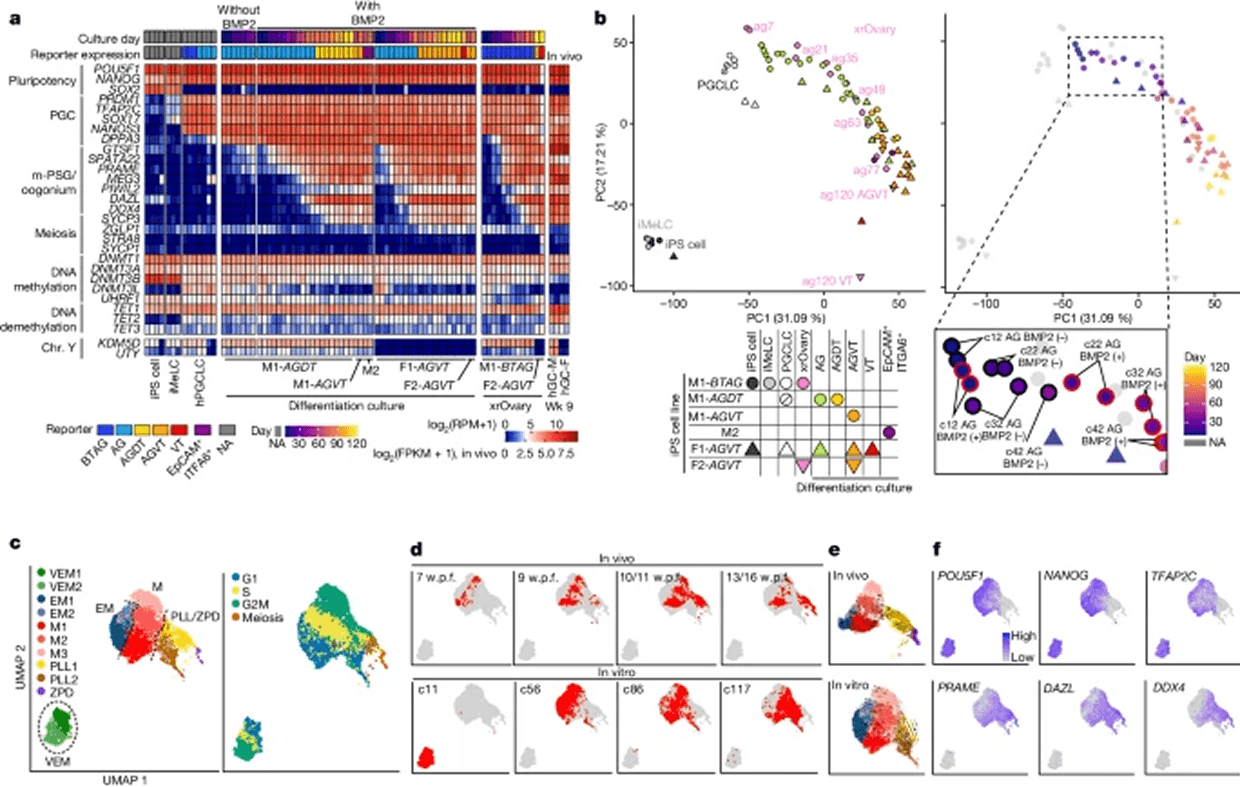
Fig 1. Title of Figure
Stem cell–based fertility research is still an evolving field, but its potential to illuminate previously inaccessible aspects of human reproduction is significant. By continuing to refine in-vitro models and deepen our understanding of germ cell biology, researchers are laying the groundwork for future advances that could one day expand reproductive options for individuals and families.
+ Source Data
Ensuring Biological Fidelity and Safety
A central challenge in stem cell–derived fertility research is ensuring that in-vitro-derived cells accurately reflect their in-vivo counterparts. Differences in gene expression, chromatin structure, or imprinting patterns can have significant downstream implications.
To address this, ongoing efforts emphasize rigorous molecular characterization, including transcriptomic and epigenetic profiling, alongside functional benchmarks where appropriate. These analyses help identify where in-vitro systems align with natural development—and where further optimization is needed.
Long-Term Implications for Fertility Care
While clinical applications remain a long-term goal, the immediate impact of this research lies in expanding foundational knowledge. Improved models of human germ cell development can inform fertility preservation strategies, clarify the effects of aging or medical treatments on reproductive potential, and support the development of safer, more targeted interventions.
Importantly, progress in this field requires patience, transparency, and close alignment with ethical and regulatory standards. Each experimental milestone is evaluated not only for technical success, but also for biological relevance and long-term responsibility.
Looking Ahead
Stem cell–based fertility research is still an evolving field, but its potential to illuminate previously inaccessible aspects of human reproduction is significant. By continuing to refine in-vitro models and deepen our understanding of germ cell biology, researchers are laying the groundwork for future advances that could one day expand reproductive options for individuals and families.
We will continue to share updates as our research progresses, focusing on what we are learning, how our models are evolving, and what these insights may mean for the future of fertility science.
+ See citations